Kamis, 31 Maret 2011

Cinema needs better lesbian profiles, says UK Film Council


A major new film study has revealed that the majority of the UK population believes more needs to be done to create an authentic portrayal of the country’s diverse audiences – including that of lesbians, gays and bisexuals.

The independent study undertaken by global research agency, Harris Interactive, on behalf of the UK Film Council, surveyed 4,315 people to uncover their views about the portrayal of diverse groups in film, focussing specifically on those who are into film.

The research highlights a number of stereotypes that are still being perpetuated in film, one of which is sexual behaviour.

A large proportion of the LGB respondents interviewed (70%) believe that film can represent them in a negative light by focusing on them having problems rather than on them being everyday people. Around four in five LGB audiences also feel that gay characters in film too often have sexual orientation as the main trait, or that gay characters are too often depicted as camp (sexual orientation - 80% LGB versus 63% of the general population; depicted as camp – 79% LGB, versus 57% of the general population).

Over three in five (64%) also think that lesbians in films are too often depicted as male sexual fantasies rather than real people.

These figures become even more important when contrasted with how powerful the general population feels the role of film has in changing behaviour. Almost 7 in 10 people (69%) believe that film has the power to tell stories that educate people about real life events, demonstrating that film doesn’t merely entertain and pass the time, but is an important medium to help change ingrained beliefs and stereotypes in society.

While things have improved over the past decade with 71% of the general public claiming that film has become more authentic in its portrayal of diverse groups over the last 10 years, a massive 90% of LGB groups believe there is more work to be done.

An interesting finding from the study also highlights that there is considerable commercial opportunity to be reaped if diverse groups are represented more authentically on film - 51% of LGB audiences say they would watch more films if this was the case.

Mary FitzPatrick, Head of Diversity at the UK Film Council and key sponsor of the research, said: “Film remains one of the most popular pastimes for people in the UK and this research highlights the often overlooked views, opinions and needs of the diverse groups that make up an important part of the film industry’s audience. Film has the ability to change behaviour and shift opinion, so we in the Industry all have a responsibility to ensure that these findings are not ignored.

"The figures speak for themselves in demonstrating there is a real opportunity for the industry to more accurately portray these groups in film. This research will form an important part of the UK Film Council’s legacy and will help make a powerful and dynamic change to the way in which diverse groups are portrayed in film going forward”.

Andrew Pierce, journalist at the Daily Mail and supporter of the research, told PinkPaper.com: “This research demonstrates just how powerful film can be in changing the views of people in society. And what is just as powerful is how it clearly shows that film roles for gay people are helping to perpetuate stereotypes.

“It is essential these findings are given the attention they deserve and that changes are put in place to ensure we include diverse groups in film, which will help to help overcome outmoded and misguided attitudes towards gay people”.
ga - 468x60

Lesbian and gay Prowler stores win community business awards

Ringkasan ini tidak tersedia. Harap klik di sini untuk melihat postingan.
ga - 468x60

World's first married lesbian couple mark 10 year anniversary


The world’s first legally-wed lesbian couple are celebrating their tenth wedding anniversary, this week.

Dutch pair Helene Faasen and Anne-Marie Thus said the secret to their success is marrying for love, not politics.

Speaking to News.Com.Au, Thus said: “We married for love. But of course we were aware it was an historic moment."

The Netherlands was the first country to legalise same-sex marriage, in 2001.

Since then, nearly 15,000 gay and lesbian couples have wed in the Netherlands - about 2 per cent of the total number of marriages registered between 2001 and 2010, based on figures from the Central Statistics Bureau.

"We wanted to make other people think about how horrible it is to be denied something that is a natural right for others,” added Faasen, 44.

“A heterosexual person never needs to think about whether he is allowed to marry or not, he simply needs to be lucky enough to find the love of his life.”
ga - 468x60

Malaysia's first gay-themed film is box office smash


Malaysia’s first gay-themed film has become a box-office success.

The Malay-language movie, called In A Bottle when translated to English, grossed slightly more than 1 million ringgit – or a quarter of a million pounds – in its first five days.

This means it recouped its production and marketing costs of 970,000 ringgit in less than one week of release.

Raja Azmi Raja Sulaiman, who wrote and produced the film, said the box-office results "prove that Malaysian audiences can handle such movies, that they're more open and not so conservative anymore," Sulaiman told The Associated Press.

"I hope it'll inspire more films that are meaningful and linked to the reality of people's lives.".

The movie, which tells the tale of a Muslim man who has a sex change operation because he believes it will please his male lover, has been commercially successful – but has also faced criticism from gay advocacy groups that it relies on lazy stereotypes.

According to ABC news, Malaysian gay rights activist Pang Khee Teik specifically voiced concerns that the film may discourage people who have valid reasons to undergo sex change surgeries.
ga - 468x60

Female teacher continues to deny pupil relationship


A female teacher has again denied allegations she had long-term lesbian relationships with two teenage students.

Caroline French, 38, is accused of having sexual relationships with two girls from two separate Blackpool schools in which she taught. One of the allegations relates to French allegedly grooming a 13-year-old with alcohol and cigarettes, with whom she then embarked on a two-year relationship.

French, of Ashtree Close in Darlington, claimed the former pupil was making up the allegations after she had rejected the girl’s advances.

The other student lived with French when she turned 16, and embarked on what is alleged to have been a three-year affair. But French insists the lodging arrangement was with the consent of the girl’s mother, and she denies any sexual element to their relationship.

As reported by the BBC, the drama teacher said: “There was no sexual relationship but I did care about her and she became part of my family.

“I really did care about her, like a mother or an aunt.”

French added: “My heart went out to her. Her mum did not want her, she had nowhere else to go and the idea was to get her back on to some solid footing.”

The trial continues at Preston Crown Court.
ga - 468x60

Cheryl Cole voted the perfect passenger

X Factor judge Cheryl Cole has been voted the dream travel companion by men and by women, according to a new nationwide survey.

The Geordie beauty topped the ‘Perfect Passenger’ poll, with women choosing her ahead of Hollywood heartthrob George Clooney and football star David Beckham.  Almost a third of men (31.6 per cent) said Parachute singer Cole was the ideal person to share a long car journey with, while a fifth of women (20.3 per cent) agreed, in the survey by car care experts Turtle Wax.

Movie legend Clooney and fashion icon Beckham could only muster 19.94 per cent each of the female vote, rendering them less popular with women than brunette Cole.  Lingerie model Kelly Brook came second in the male poll with a quarter of the vote (25.62 per cent), followed by screen siren Cameron Diaz with 13 per cent.

While women chose Twilight star Robert Pattinson as their third favourite travel buddy, with 11.31 per cent of the vote.

Andrew Freeman, European marketing director at Turtle Wax, who commissioned the survey of 3,000 people, said: “People will be shocked that many women chose Cheryl ahead of the likes of David Beckham and George Clooney but this just goes to prove how popular she is. Thanks to her role as an X Factor judge lots of people believe they know the real Cheryl and they like what they have seen and heard.”

There was more bad news for Katie Price – aka Jordan – as she was voted the person people would least like to share a long car journey with. A quarter of men and women said the model and reality TV star would be their idea of a nightmare passenger.  Dancing on Ice loser Kerry Katona was voted second worst travel companion, with a fifth of the female vote (20.8 per cent) and 15 per cent of men choosing her. She was followed by troubled singer Amy Winehouse, who was chosen by 13 per cent of men and women.
ga - 468x60

Government Nest subsidy could reach £379m

john_lawson.The Government could end up providing Nest with a subsidy of up to £379m if take-up volumes are below expectations, Government figures show.

A European Commission policy document, published today, confirms the UK Government loan for setting up and running the scheme does not contravene EU state aid rules.

The UK Government predicts Nest’s set-up costs to be between £105m and £117m.

However, Standard Life head of pension policy John Lawson (pictured) says the figures are “light” and expects the set-up costs to breach the £250m mark.

The Government predicts the scheme will take 20 - 27 years to break even, based on take-up of 3m to 6m people by September 2016. Its total costs, including set-up and operating costs, are expected to be between £856m and £938m over the first 10 years.

Based on these figures, the Government estimates Nest will need a loan of £904m, with an additional subsidy of £235m.

However if there are low volumes of take-up, a loan of £1.275bn could be necessary, with the scheme receiving a subsidy of £379m.

Nest will apply a contribution charge of 1.8 per cent on members in order to recover the costs of setting up and running the scheme. The Government loan will be paid back through this charge.

Lawson says: “Nest faces an uphill struggle to break even. I think it is vastly overestimating the size of its target market, which I would expect to be around the two million mark.”

Nest Corporation’s costs could reach £325m, or £46m a year, between 2010/11 and 2017/18.

Nest is expected to employ 1,231 full-time staff over the period.
ga - 468x60

Rabu, 30 Maret 2011

Pret A Manger boosted by sales of 50,000 porridge pots a week

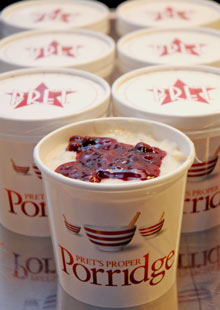
http://static.guim.co.uk/sys-images/Business/Pix/pictures/2011/3/29/1301386276089/Pret-A-Mangers-porridge-005.jpgFor years it has been a distant reminder of Britain's austere past and of the days before fancy cereals and continental breakfasts. But it seems that the humble bowl of porridge is helping us fend off cold weather and the looming threat of a double-dip recession.

Britons have turned in their droves to a comfort breakfast of porridge, and sandwich chain Pret A Manger has announced that it is selling 50,000 bowls of the stuff every week.

Drizzled with a "luscious fruits of the forest compote", the £1.99 pots of slow-cooked jumbo oats don't sound like the product of austerity Britain to rank with rationing or the three-day week but Pret nevertheless believes that the offer launched a year ago chimes with straitened times.

"Porridge is an affordable product, and a product of the economic times we are living in," a spokesman said.

The cold weather of recent winters has boosted overall sales of porridge oats in Britain but there may also be other factors at work. Porridge is renowned as a healthy breakfast option without the sugars that are present in other cereals. It is high in fibre and protein and can help people to lose weight because it is digested slowly. It also helps lower cholesterol.

The 300g pots have helped push Pret's sales up by 17% to £328m, and profits up by 37% to £46m. Pret's 4,000 staff are collecting £2,000 bonuses each on the back of the strong performance, the company said.Opened in London in 1986, the company was temporarily part-owned by McDonald's, but is now majority owned by private equity group Bridgepoint, who bought a stake in February 2008 which valued the group at £345m, including debt. Management are also investors in the business.

Pret said it intended to set up 30 new shops around the world in the coming year, creating 700 new jobs, 500 of which will be in the UK.Separately, rival Eat has announced that private equity group Lyceum Capital had bought a stake. The company would not say how big the investment was, but did say that it would help support "a significant store roll-out and brand development programme."

Eat currently has 110 stores, and is planning to double in size in the UK over the next few years, as well as pursuing international growth.
ga - 468x60

New study and treatment available for kids facing phobias

“Anxiety disorders are among the most common problems experienced by kids, with up to five per cent of young people experiencing an anxiety disorder at any one time”, says Simon Byrne who is leading the study.

“Very often the anxiety or fear is related to an animal. Two of the most common animal phobias in kids are a fear of dogs and a fear of spiders”, he said.

“These phobias can cause considerable distress to a child as they grow up. Phobias can also cause problems for parents who may have to constantly reassure their child when they are anxious or upset. For example, a child who is fearful of dogs may be too afraid to walk down a street alone where they once saw a dog. Or a child who is very frightened of spiders may be too scared to go to sleep at night in their bedroom.”

Byrne said effective treatment for phobias involves helping a child gradually face what they are frightened of in a process called graded exposure therapy. For example, a child who is dog phobic may be encouraged to calmly and gently approach a live dog in the presence of a therapist until they are no longer fearful. However, some kids do not improve with exposure therapy alone, so new and more effective treatments need to be developed to help kids get better and stay well,” Byrne said.

A new medication called D-Cycloserine (DCS) is now being trialed in conjunction with exposure therapy for treating phobic kids. “DCS has shown to improve the chances of a faster and complete recovery when given just before an exposure session. The medication is very safe, just like taking a dose of antibiotic. This new discovery could drastically change how anxiety disorders in young people are treated”, Byrne said.

“During the exposure, the child is learning that they no longer need to be frightened of what they once feared. DCS is believed to improve this process by more effectively storing this new “non-fearful” learning in memory. By strengthening this new “non-fearful learning”, the child is less likely to become frightened the next time they see a dog or spider,” Byrne said. “This is one of the first studies in the world to trial DCS for treating anxious kids”, Byrne said.

This particular treatment takes place at Macquarie’s University’s Emotional Health Clinic. The treatment is quick, effective and free. Criteria for the study include: The young person needs to be aged between 8–14 years. They should be so fearful of spiders or dogs that it is interferes with their life. The young person has to want to get help for their phobia.
ga - 468x60

Selasa, 29 Maret 2011

DS not dead: Pokémon 'Black' and 'White' reach 2 million sales in 2 weeks

http://www.independent.co.uk/multimedia/dynamic/00533/pokewhite_151e21625_533503t.jpgNintendo's most recent pair of pocket monster games has accumulated 2 million US sales in as many weeks since a March 6 release.

Japanese players, meanwhile, bought 2.5 million copies of either Pokémon Black or White in the same period of time, with the duo reaching a combined 5.1 million mark in the six months since its domestic debut, September 2010.

Despite the enduring popularity of the Pokémon series, Nintendo instead chose to present Nintendogs + Cats, Pilotwings Resort and Steel Diver as its first-party launch titles for the brand new Nintendo 3DS.

3DS versions of other recognizable names such as Mario and Zelda have also been held back in order to allow third-party publishers a chance to establish themselves on the 3DS.
ga - 468x60

Can caffeine make us healthy?

http://www.independent.co.uk/multimedia/dynamic/00588/caffeine_588250t.jpgFor years we have been told to beware of caffeine. Now we seem to have swung in the opposite direction, with studies claiming that moderate amounts of coffee may reduce headaches and protect against diabetes, Alzheimer's and heart disease, among others. So where does the truth lie?

We don't all have the same reactions to caffeine, Mehul Dhinoja, a consultant cardiologist at BMI London Independent Hospital, says.

"Each of us has an enzyme in the liver that breaks down and metabolises caffeine. It's that process that enables caffeine to have its effect around the body," he says. "Some people are born with an enzyme that works extremely efficiently and others have quite the opposite. Because this isn't controlled in studies about caffeine, it's not surprising to find statistical contradictions."
Peter Rogers, head of experimental psychology, says some people are more sensitive to the effects of caffeine, while others develop a tolerance. "One of the things caffeine has been found to do is increase blood pressure and make your hands shake a little," he says. "But actually this depends if you're a person who regularly consumes caffeine."

You can even develop a dependence of caffeine so that without it, you can feel fatigued and headachey, he says. "That's why if coffee drinkers haven't had caffeine for a while – for example, overnight – the coffee they have in the morning is likely to make them feel more energetic and alert, while for a non-regular drinker, it will make them jittery."

So while some studies say coffee stimulates the brain and makes drinkers feel more awake, Rogers and his team have found the "caffeine high" may just be a reaction to the body craving the drug. Caffeine may even have radically different effects on the sexes. Studies from Bristol University have found that drinking caffeinated coffee boosted a woman's performance in stressful situations, but had the opposite effect on men, who became less confident and took longer to complete tasks once they had several coffees.

What caffeine is good for

Forget hair of the dog. If you want to cure a hangover, a good old cup of coffee and aspirin really is best, according to a new study from Thomas Jefferson University in Philadelphia. Confirming what many have suspected for years, the research found that the caffeine in coffee and the anti-inflammatory ingredients of aspirin reacted against the chemical compounds of ethanol, or pure alcohol, which – even in small doses – can bring on headaches.

Tim Grattan, who developed the technology for the new paracetamol and caffeine product, Panado Extra Advance, isn't surprised: "There's plenty of clinical evidence that shows caffeine actually speeds up the painkilling properties of various painkillers. In fact, caffeine has played a role in making our new product 37 per cent more tough on pain than ordinary paracetamol tablets."

Drinking lots of coffee can also boost sports performance by as much as 6 per cent – but, critically, only in any activity where muscles are not being worked to the limit, meaning coffee or tea could benefit a long-distance runner but not a sprinter.

Rob James, from the University of Coventry's department of Biomolecular and Sports Science, believes caffeine in the bloodstream may influence receptors on skeletal muscle, making a person temporarily more powerful. If you overdo it, fear not – caffeine can help here, too. A study from the University of Georgia found that caffeine can help reduce the soreness that discourages some people from keeping up their workouts.

What it's bad for

Contrary to popular opinion, one thing coffee doesn't do is sober you up – it may even further impair your judgement, scientists at Temple University in Philadelphia have found. Combining alcohol and caffeine at the same time produces a potentially lethal mix that makes it harder to realise you are drunk, according to the study published in Behavioural Neuroscience. Perhaps less of a surprise is the discovery that energy drinks – some of them, at least – are bad for our health. "There have been increasing instances of atrial fibrillation (AF), a heart-rhythm problem, among young people who consume large amounts of energy drinks," Dhinoja says. It's not just drinks that can cause this problem. In 2009, a 13-year-old boy needed hospital treatment after ingesting "energy" chewing gum that contained 320mg of caffeine – more than in three cups of coffee.

Large amounts of caffeine in pregnancy also appear to be risky. Back in 2008, the Food Standards Agency warned women to have no more than two cups of coffee a day after a study linked caffeine to low birth weight. Caffeine may affect your chances of getting pregnant in the first place, too, according to a Netherlands study that found that women who drank four cups of coffee a day were 26 per cent less likely than average to have conceived naturally.

Caffeine could even shrink some women's breasts. Swedish research found that too much of it can affect hormones, playing havoc with their bust size.

Cancer and heart disease

An analysis of 59 studies just published on the BioMed Central Cancer website suggests that coffee consumption may reduce your overall risk of getting cancer and that it may be inversely associated with the risk of bladder, breast, pharynx, pancreas and prostate cancers and leukaemia, among others. One study even discovered that caffeine can cut the risk of skin cancer by more than a third.

But women who drink more than four cups of coffee a day increase their risk of developing breast cancer by a third, according to Harvard University. A high caffeine intake can also increase the chance of developing larger tumours, which are harder to treat.

The jury is still out on caffeine's relationship with the heart, too. Arthur Klatsky, a cardiologist, and his team at the Kaiser Permanente Division of Research in California discovered that regular coffee drinkers were less likely to be treated in hospital for irregular heartbeats or rhythms. The more cups of coffee they drank each day, the less likely they were to suffer from the condition. Spanish research has even shown that women who drink three cups a day could reduce their risk of dying from heart disease by a quarter, whilst another study found that men who drank five or more cups a day were 44 per cent less likely to die from the disease.

Other factors

Women who drink tea were recently found by American researchers to be at greater risk of developing rheumatoid arthritis. Other studies have shown tea drinkers can halve their risk of dementia and cut their risk of a stroke. Yet the same cannot be said about coffee drinkers. "This highlights a really important point – that the other constituents in tea and coffee may have their very own impact on health and well-being," Rogers says.

Australian scientists found that drinking three to four cups of coffee a day can lower the risk of type 2 diabetes by 25 per cent, but those who drank decaffeinated coffee showed similar results. And a study of almost 50,000 men found that those who drank the most coffee were 60 per cent less likely to develop the most aggressive form of prostate cancer.

Should we give it up?

Doctors often tell patients to quit caffeine, but that may not be necessary, Rogers says. "It seems to me odd to be telling someone to give up something they enjoy and when there's no real evidence." Rogers followed a group of people with tinnitus – a condition for which caffeine has traditionally been deemed by doctors as a big no-no. "We found that those who did give up caffeine didn't improve their condition in any way." He adds: "Not to undermine the importance of my own research, but tea and coffee are things to worry about so much less than if you're a smoker, overweight or have a poor diet."
ga - 468x60

Senin, 28 Maret 2011

Miliband on 'Yes' vote platform

http://www.belfasttelegraph.co.uk/multimedia/dynamic/00534/UK_News_8-1_jpg_534421t.jpgLabour leader Ed Miliband is to join former Liberal Democrat chief Charles Kennedy and the Green Party's Caroline Lucas on a cross-party platform to call for a Yes vote in the referendum on voting reform.

The event in Westminster on Tuesday will also involve several other leading politicians from Labour, the Liberal Democrats and the Greens, including Tessa Jowell and Baroness Shirley Williams.

Although both Labour and the Lib Dems officially support a Yes vote in the May 5 referendum on introducing the Alternative Vote for Westminster elections, there has been tension over whether their leaders would be willing to campaign together.

Mr Miliband has said he will not share a platform with Lib Dem leader Nick Clegg, advising the Deputy Prime Minister to "lie low" during the AV debate to avoid damaging the pro-reform camp's prospects.

A planned event which would have brought the Labour leader and Mr Kennedy together was cancelled earlier this month amid reports of behind-the-scenes disagreements over the line-up.

Announcing the press conference, Yes to Fairer Votes chair Katie Ghose said: "We're a people's campaign. We're all in this because we believe in politics. We welcome cross-party support to help us change the country's rotten voting system once and for all.

"We have volunteers out campaigning in every seat across the country. We have people who've never campaigned for any party - but we all understand this is our one opportunity to change politics, for good."
ga - 468x60

'Substantial' bomb at courthouse

http://www.belfasttelegraph.co.uk/multimedia/dynamic/00534/UK_News_7-1_jpg_534381t.jpgA substantial and viable bomb was planted near a Northern Ireland courthouse on Sunday, police said.

Dozens of elderly residents were moved from a sheltered housing development in Londonderry due to the alert blamed on suspected dissident republicans.

Choirboys, some as young as seven, were told to get out of the nearby St Columb's Cathedral.

Monday's hearings at the courthouse have been moved to other courts.

A Police Service of Northern Ireland (PSNI) spokesman said: "A number of controlled explosions have been carried out and we can now confirm there is a viable device of substantial size."

The area around remains sealed off.

It is two years since the threat from dissident republicans in Northern Ireland was escalated to severe. The groups have been particularly active in the Derry area.

SDLP Foyle representative Pol Callaghan condemned the disruption, saying: "This is a totally unacceptable and pointless attack on our city. Elderly residents of Alexander House have yet again been put out of their home, causing upset and distress. It has caused widespread disruption to traffic. I have met visitors from the US, the Republic (of Ireland) and elsewhere whose visits have been affected."

Sinn Fein assembly candidate Martina Anderson said she had a message for the bombers.

"The people's focus will be back on building for the future as soon as the debris is cleared but you will still be stuck in the past with not a progressive thought between you. So get real, pack up your tent and go home," she said. "The peace and political processes will continue to strengthen in spite of the wreckers."
ga - 468x60

Ulster furniture retailer goes into liquidation

A Northern Ireland furniture retailer has gone into liquidation after more than 30 years in business with the loss of at least 20 jobs.

Ardis furniture shops in Belfast and Lisburn, gift shops in Saintfield and Banbridge and its 50,000 sq ft flagship store in Gilford have all closed.

As well as shop floor staff, employees in the flagship store's cafe and design studio have also lost their posts.

However, founder David Ardis told the Belfast Telegraph: "Work is ongoing to salvage the cafe as well as the design and manufacturing divisions of the business."

A two-day liquidation sale was held over Friday and Saturday, with the remaining furniture stock sold at discounted prices from the Gilford premises.

Mr Ardis founded Ardis Living in 1976. In 2003, the large anchor store opened in Gilford and the group embarked on further expansion in March 2006 with the acquisition of Lisburn furniture store Warwick Living.

In October of that year, Ardis Living took over Gilbert Logan, the furniture manufacturer and retailer established in Belfast in 1926. The company's founder famously created the captain's table and other furniture items for the doomed Titanic ocean liner.

Dr Karise Hutchinson, a lecturer at the University of Ulster's department of business, retail and finance, told the Belfast Telegraph large discount stores are putting pressure on independent retailers.

"When you have Ikea in the province, it is difficult to compete on style and value for money," said Dr Hutchinson.

"A smaller shop doesn't have the economies of scale or buying power needed. Consumers are price sensitive, but they still want nice things for their homes, especially when times are tight.

"They are less likely to be moving house and will be spending more time at home as they can't afford to go out socialising."

She also suggested banks had some responsibility.

"Shops like these need to invest heavily in stock and unless they are able to borrow, they won't be able to buy in what they need," she added.

Ardis Living is the latest furniture retailer to go out of business in recent weeks. Earlier this month, Dekko closed its stores on Belfast's Boucher Road and the Junction One shopping complex in Co Antrim.

Founder and managing director Michael Bambrick said uncertainty over job and income prospects during the recession was leading people to defer furniture buys.
ga - 468x60

I'm eating myself to death: Nolan


BBC heavyweight Stephen Nolan has said he is a dead man walking — if he doesn’t win his battle with the bulge.

He has filmed a hard-hitting documentary to educate and warn people of the problems of obesity crippling the health service here and killing HUNDREDS a year.

And in next week’s shock programme Dead Fat, a remarkably candid Nolan himself confesses: “Fat is killing me.”

The Belfast-born TV and radio star, 37, says: “I started to make this programme because I'm scared to death about my weight, really scared. I went in search of the truth even though I knew it was going to hurt."

For the full story, see this week's Sunday Life.
ga - 468x60

Minggu, 27 Maret 2011

A giraffe’s shocking neck


NASA’s Wide-field Infrared Survey Explorer took its last image of the sky in February, 2011. But while it was active it surveyed the entire sky several times in the far infrared, so its data archive is a vast treasure trove just waiting to be dug into (hmmm, I should try to squeeze another metaphor into there).

Anyway, lookee what the astronomers found:
Cooool. Literally! That’s dust surrounding the star Alpha Camelopardalis, what appears as a fairly non-descript star in a faint, non-descript constellation. At least, to the eye. When seen in the IR, you get this shocking view. Also literally.

Alpha Cam is a massive, luminous star: 50 times as hefty as our Sun, and blasting out perhaps a million times as much energy. But it’s far away (3000 light years, maybe, the distance is not well-known) and behind a lot of dust, dimming our view. It’s barreling through space at a pretty good clip, and emitting a wind of subatomic particles as it does. This wind expands, slams into the surrounding dust, and sculpting it into this giant bow shock formation.

In this false color shot, red is gas and dust warmed to about 130K — that’s -140°C or -200°F! — so warmed is maybe not the best word. But it would be a lot colder if the star’s wind weren’t ramming through it. Green comes from dust at about 240K, or -33°C (-27°F).

Interestingly, the visible light picture is similar. This shot, from NASA, is sensitive to hydrogen gas. As the wind from the star rams the surrounding material, it carves a bubble on a much larger scale than shown in the WISE image.

One day, not too far in the future — a million years, give or take — Alpha Cam will blow, becoming a supernova. It’ll outshine Venus by a fair shot when it does, too. Material ejected in the tremendous explosion will scream outward at a good percentage of the speed of light, and when it hits that junk floating around the star, then we’ll really see a show!
ga - 468x60

CT Scan of Nanotyrannus (CMNH 7541)

The Cleveland tyrannosaur skull (Nanotyrannus or Tyrannosaurus): new findings based on ct scanning, with special reference to the braincase. Lawrence M. Witmer & Ryan C. Ridgely, Kirtlandia 37: 61-81.
Abstract: The Cleveland Museum of Natural History’s skull of a small tyrannosaurid theropod dinosaur (CMNH 7541) collected from the Hell Creek Formation has sparked controversy, with competing hypotheses suggesting that it represents a separate taxon of dwarf tyrannosaurid (Nanotyrannus lancensis), a juvenile specimen of Tyrannosaurus rex (the only other acknowledged Hell Creek tyrannosaurid), or a compromise position (a juvenile Nanotyrannus). Beyond this controversy, CMNH 7541 holds importance because of the anatomical information that such a well preserved skull can provide, and it is in this context that we have sought to probe the structure of the braincase region (e.g., pneumatic sinuses, cranial nerve foramina), as well as other regions of the skull.

We subjected the skull to computed x-ray tomography (CT scanning), followed by computer analysis and 3D visualization. The braincase and a number of other bones (e.g., vomer, quadrate, quadratojugal, palatine, mandible) were digitally "extracted" from the CT datasets. Although the new findings strongly confirm the long-held view that CMNH 7541 pertains to a tyrannosaurid, the mosaic of characters it presents makes finer taxonomic assignment difficult. For example, some characters support affinities with T. rex, yet other characters argue for a much more basal position.

The key question that awaits resolution is whether the differences observed can be attributed to juvenility, and such resolution will require information from new, as yet unpublished specimens. Nevertheless, some of the differences seen in CMNH 7541 (e.g., the pattern of pneumatic foramina in the basicranium) are highly divergent and are harder to attribute to ontogeny. Among other findings, we report here thin, laminar structures within the main nasal airway that are interpretable as being respiratory turbinates, which have potential implications for metabolic physiology.
ga - 468x60

Sabtu, 26 Maret 2011

Dundee Utd 1-1 Hearts, March 21, 1995

A FINE individual performance from Allan Johnston helped Hearts take a point at Tannadice which consolidated the Jambos' mid-table position but did little to ease Dundee United's worries as they remained in the relegation zone.
Johnston's first goal for Hearts in eight months extended his side's unbeaten run and might have secured all three points but for a goal from United's Sergio which was the result of slack defending at a set-piece.
Hearts manager Tommy McLean woul

d be reasonably pleased with his side's performance in the light of the severe injury list which meant that the Tynecastle club were eight players short of their strongest side.

Hearts started the fixture without the services of John Robertson, Dave McPherson, Kevin Thomas, Colin Miller and Brian Hamilton. And although Craig Levein returned to captain the side from central defence, there was a makeshift look about other areas of the team with Gary Mackay slotting in at left-back.

United had much of the possession during the first half but were unable to find the cutting edge needed in attack even though caretaker manager Gordon Wallace had opted for a 4-3-3 formation in which Craig Brewster and Christian Dailly were supported by the Brazilian striker, Sergio. Encouraged by yet another shrewd performance from Jim Bett, Hearts defended comfortably and looked the more likely team to score on the counter attack.

That they did before half an hour played when Mackay's long ball caused confusion between Gordan Petric and Maurice Malpas in the United defence with the latter eventually settling for a header back towards his goalkeeper only to misjudge the pace of the ball. Johnston nipped in and from 12 yards hooked a delightful effort over the head of Kelham O'Hanlon into the top left-hand corner of the net. United attempted to move up a gear at the start of the second half but continued to find scoring opportunities hard to come by.

Hearts' defensive combination of Levein, Neil Berry and Willie Jamieson was solid and gave United's forwards few opportunities to shine. United didn't look like equalising until an error by Nelson in the 67th minute helped to put the Tangerines back on level terms. Billy McKinlay's corner was well struck and although Nelson came out to clear, he could only get a faint touch on the ball. Brewster then nodded the ball back into the six-yard box and Sergio clipped the ball into the net from point-blank range.
ga - 468x60

Rare dinosaur found in Canada's oil sands

The Canadian oil sands, a vast expanse of tar and sand being mined for crude oil, yielded treasure of another kind this week when an oil company worker unearthed a 110-million-year-old dinosaur fossil that wasn't supposed to be there.

The fossil is an ankylosaur, a plant-eating dinosaur with powerful limbs, armor plating and a club-like tail. Finding it in this region of northern Alberta was a surprise because millions of years ago the area was covered by water.

"We've never found a dinosaur in this location," Donald Henderson, a curator at Alberta's Royal Tyrrell Museum, which is devoted to dinosaurs, said on Friday. "Because the area was once a sea, most finds are invertebrates such as clams and ammonites."

The ankylosaur that was found by the oil worker is expected to be about 5 meters (16-1/2 feet) long and 2 meters (6-1/2 feet) wide.

"It is pretty amazing that it survived in such good condition," said Henderson, noting the fossil was three dimensional, not flattened by the heavy rock sediment.

"It is also the earliest complete dinosaur that we have from this province."

The fossil was found on Wednesday by a Suncor Energy shovel operator who was clearing ground ahead of development. By a quirk of fate, the worker had visited the Royal Tyrrell dinosaur museum in southern Alberta just the week before.

Henderson suggested he may have had dinosaurs on the brain. "Maybe his mind was subconsciously prepared."

Suncor has suspended work at the site and has given scientists a three-week window to remove the fossil and ship it to the Royal Tyrrell museum.

The last major fossil find in northern Alberta was a giant reptile called an ichthyosaur, which was found 10 years ago near Fort McMurray.
ga - 468x60

Jumat, 25 Maret 2011

Chevrolet Volt: Thinking Person’s Car, Or a Car That Thinks?

http://blogs-images.forbes.com/matthewdepaula/files/2011/03/IMG_6202.jpgThis is part of a Forbes conversation that will appear online over the next few days. Auto writer Hannah Elliott and I are debating the practicality, performance and appeal of cars that run on diesel, electricity, natural gas and other non-gasoline fuels. An edited version will appear in a future issue of Forbes magazine. Please weigh in with your own comments.
Chevrolet Volt parked in a garage - Credit: Matthew de Paula

Chevrolet Volt - Image by Matthew de Paula

I’m not going to say that cool factor doesn’t matter to me. It’s just not as big of a priority as it is for fellow auto writer Hannah Elliott, based on what she writes about the Chevrolet Volt here.

But one thing I do care about that she does too, is whether a car has soul.

Hannah dinged the Nissan Leaf for not having any, and I can’t say I blame her. This despite previously arguing that with a car like the Leaf, more efficiency is the goal, even if it means less soul.

Well, fortunately for General Motors, its darling Chevy Volt—on which the company hangs much, if not all, of its reputation—has got soul.

It seems to have a personality, in fact. The Volt does things on its own—turn on the gas engine when the battery charge gets low; turn on the engine when you pop the hood; chirp and flash some fancy graphics on its two large screens as it comes to life after sitting unattended.

This is not what we’re used to. Drivers have been trained to give an input, and get a response: turn key, start engine; press brake, slow down.
ga - 468x60

Test Drive: Chevrolet Volt Gives a Jolt Toward the Future

http://blogs-images.forbes.com/matthewdepaula/files/2011/03/IMG_6188.jpgEight miles until the battery would be completely drained. As I pulled down the driveway and onto the street, the readout dropped to five miles.

“So what?” I thought, even though my destination was at least 15 miles out.

The Chevrolet Volt has a small gasoline engine onboard to recharge its lithium-ion battery pack. With a full tank, I could go 260 miles. Good thing—because the garage I parked it in overnight had no plug outlet.

Of the cars Hannah Elliott and I have driven so far as part of a series looking at alternative-fuel options, the Chevrolet Volt has made the biggest impact on me, personally.

This plug-in hybrid does live up to all the hype—a true omen to the future of automobiles. But it’s not without faults.

While we didn’t put that many miles on the Chevrolet Volt, the ones we did taught us a lot.

The car’s two large screens are always flickering with information. After my last drive, the screen behind the steering wheel, which shows a digital speedometer and myriad other information, read as follows:

Miles driven on electricity: 23.5
Miles driven on gas: 6.8
Total miles per charge: 30.4
Miles per gallon: 91.7

It was 42 degrees and rainy the morning I drove the Volt into Manhattan for the last time. That probably helps explain why the mileage estimate dropped by three miles after pulling out of the garage and onto the street: heater and windshield wipers drain the batteries faster, and the Volt—smart cookie that it is—accounted for that.

The Volt wants you to get better mileage and coaches you toward it. But I mostly ignored its efforts, partly not to piss off impatient New York drivers, but more importantly, to see how it behaved when treated like any other car.

A pie chart in one of the menus on the center console’s large screen showed that my driving style wasn’t as efficient as it could be, at only 50 percent efficiency. Another pie chart showed energy consumption from climate control and other functions was equally wasteful.

Had I used the seat heaters instead of the heating vents, I could’ve gotten more miles out of the battery charge, according to one of the menus with a laundry-list of advice. Keeping it below 50 mph on the highway was another mileage-boosting tip I didn’t follow while blasting down FDR Drive. I think that’s when I noticed the gas engine kick on and stay on for the rest of the drive.

You don’t feel much when the engine activates, because it never does actually drive the wheels—it only recharges the battery. Electric motors are what propel the Volt, except in very unique circumstance like steady-state cruising, when the gas engine does help out.

With the radio off at a stop light, or while driving in slow traffic, I could barely hear noise from the engine. More perceptible was a subtle vibration felt through the steering wheel and seat of the pants—kind of like happens in a Toyota Prius or other hybrid, once it goes from electric-only to gas/electric mode.

I could’ve gotten better fuel economy if I had accelerated less aggressively and braked more smoothly. There’s even a meter to the left of the speedometer designed to help with that: A green globe in the middle of a graph stays centered like the bubble on a carpenter’s level when the car is operating at optimum efficiency; accelerate or brake too aggressively and the globe moves up or down. Just don’t get in a wreck by fixating on it.

There’s also a special drive mode for gridlocked traffic. It conserves energy by changing the throttle and brake settings so you have to brake less—lift off the gas and the car slows down quickly.

I only used that mode once, but I liked it. The car stayed in “Sport” mode most of the time. The added acceleration you get over the car’s standard mode is downright fun.

Even driving over 45 mph, you can get a nice jolt of acceleration. I must’ve enjoyed that a bit too much, because before I got on the highway, my average mpg was around 160. Once I got off, it dropped to 91.7.

The car’s “normal” driving mode makes it feel more like the Nissan Leaf. Acceleration isn’t nearly as brisk.

The Chevrolet Volt is sportier than the Nissan Leaf in other ways, too. The steering and suspension feel tauter, and you sit lower to the ground—hunkered down, almost like you’re in a sports car.

That last part I didn’t like so much—I prefer the open, airy feel of the Leaf over the more claustrophobic Volt, with its limited sight lines. But the interior does feel high-quality and special, with its white console, touch-sensitive controls, stitched leather surfaces, huge screens and sculpted dash. Even  the split rear seat creates a unique experience.

Front seats are very comfortable, and although headroom is tight all around, the rear is accommodating enough for two average-sized adults.

As far as negatives go, I’m not a fan of the gaudy graphic treatment on the Volt’s door panels. And the white console washes out buttons because it reflects glare. The buttons themselves, though, work much better than Ford’s sluggish MyTouch controls.

Visibility to the rear could be better. And while the split rear seats look cool and allow access to the decently sized trunk from inside the car, I think the design lets in more road noise. That said, the interior is quiet enough as it is.

One thing that’s kind of odd, but not a big deal at all, is that the rise and fall of engine noise doesn’t match acceleration. Since the engine doesn’t actually drive the wheels, it ramps up and down on its own, like there’s a lag between its response to your right foot. Again, not a big deal, it’s just not something we’re used to.

I was amazed at how much attention the Volt got, despite its understated design. It goes to show that this car is special—which you can see and feel when you’re around it.

That will help take the sting out of its relatively high price tag—or high for a Chevy, anyway. And that, perhaps, might be the biggest sticking point.

People must ask themselves whether the Volt’s premium over a Nissan Leaf, Ford Fusion Hybrid, Honda Insight, Toyota Prius or any number of other hybrids is worth it. For the type of tech-focused, affluent early adopters that General Motors says it’s targeting, I think it is.
ga - 468x60

Smart Fortwo Electric Drive: Tiny Car, Humongous Price Tag

http://blogs-images.forbes.com/matthewdepaula/files/2011/02/Smart-Fortwo-EV-2-High-Res.jpgAn electric Smart car is on the streets.

Smart USA has delivered the first of 250 Fortwo Electric Drive cars as part of an early-adopter leasing program. The lease rate is $599 a month for a coupe and $649 a month for a cabriolet, not including a security deposit, tax, title, license and dealer fees.

Smart’s lease price factors in a $7,500 federal subsidy for electric vehicles. State or local subsidies might be available to further reduce the cost.

Mini charges $850 a month to lease an experimental electric powered version of its Cooper, called the Mini E, which like the Smart Fortwo, only seats two occupants.

Drivers interested in owning an electric car must also factor in the cost to have their home inspected by a certified electrician and, if necessary, pay to have a circuit added. This can cost anywhere from $300 to $3,000, sources say, depending on where you live and what type of work needs to be done.

At a rate of $599 a month for the required four-year lease term, owners will pay a minimum of $28,752 for a Smart Fortwo Electric Drive.

The Nissan Leaf electric car, which seats five instead of just two, starts at $26,200, including the federal subsidy. It is more powerful, more comfortable and can go farther on a single charge than the Smart Fortwo.

UPDATE: Rick Burgoise, director of communications for Smart USA, said that comparing the price of the Smart Fortwo Electric Drive to the Nissan Leaf is like comparing apples to oranges, because the Fortwo is still under development and the Leaf is a production vehicle. The production version of the Fortwo Electric Drive slated to go on sale in 2012 will be a better comparison in terms of pricing, he said. But that car is still 18 months out, so he couldn’t give specifics.

The first Fortwo Electric Drive owner, Mindy Kimball, 36, of Silver Spring, Md., is a major in the United States Army and volunteers at The Climate Project, a nonprofit associated with Al Gore that educates on climate change. She is also an active member of the Electric Vehicle Association of Washington, D.C. Her background is exactly what Smart is looking for as it selects Fortwo Electric Drive owners: They must have enough knowledge and interest in electric cars to act as ambassadors.

Besides private individuals like Kimball, Smart is targeting companies, municipalities and other organizations willing to commit to a four year/40,000 mile lease. Geographically, the company is focusing on areas that already have charging infrastructure in place or have federal grants to get it up and running.

The Smart Fortwo Electric Drive uses an electric motor powered by lithium-ion batteries.  On paper, it’s supposed to be able to travel up to 98 miles on a full charge. But in combined city and highway driving, the U.S. Environmental Protection Agency estimates the range to be 63 miles.

Using a 220-volt outlet, the batteries take 8 hours to fully charge. They take 3.5 hours to charge from a state of 20% to 80% capacity.
Smart Fortwo Electric Drive

Smart Fortwo Electric Drive - Image by Matthew de Paula

Last fall, I did a short test drive of the electric Smart Fortwo in the photo to the right and found it to be just fine for basic transport. It accelerates like a normal car, but when it gets up to 40 mph or so, the power plateaus — push the accelerator to the floor, and it just slowly picks up speed.

Other than the propulsion system, the Smart Fortwo Electric Drive behaved just like a regular Fortwo, which is to say that the ride is a bit choppy, but surprisingly stable for such a small vehicle. You don’t feel like you’re driving a clown car, but the interior isn’t as quiet or accomodating as that of the Nissan Leaf.

Smart will use its early adopter program, which it calls “Team 250,” as a field trial to test and improve the electric-drive technology, much like Mini has been doing over the past couple of years with its own lease program for the Mini E electric car.
ga - 468x60

New Baby Benz a Sign of Things to Come: Efficient Luxury

Side view of the Mercedes C-Class CoupeEfficiency is becoming the new paradigm of luxury cars.

After years of offering only high-power, high-consumption six-, eight-, and 12-cylinder engines, BMW, Land Rover and Mercedes-Benz will start rolling out efficient four-cylinder engines in the United States this year. Meanwhile, Acura, Audi and Lexus, which already offered small efficient engines, are refining them with new technology to further boost fuel economy.

Smaller engines and smaller cars aren’t new to luxury automakers. They’ve been selling them for years in Europe, where legislation on exhaust emissions creates a powerful incentive for automakers to produce highly efficient vehicles, and steep fuel taxes encourage drivers to buy them.

The United States is headed down a similar path, with stricter Corporate Average Fuel Economy standards going into effect over the next several years. So luxury automakers are responding, not only with four-cylinder engines, but hybrids and other fuel-saving technology as well.

Mercedes-Benz’s new C-Class Coupe is one of several smaller, more fuel-efficient luxury vehicles coming to the United States this year. It will offer a new four cylinder that is turbocharged to produce 201 horsepower and 229 pounds-feet of torque.

The new C-Class Coupe with this engine — called the C250 — will get an estimated 24 miles per gallon in combined city and highway driving. It goes on sale this September.

The C-Class Coupe will also be available with a 302-hp six-cylinder engine that gets an estimated 22 mpg. That model will be called the C350.
Rear view of the Mercedes C-Class Coupe, also called the C250

Mercedes-Benz C-Class Coupe - Credit: Mercedes

The last time Mercedes offered a four-cylinder engine in the United States was in the 2005 C230 coupe and sedan. They didn’t sell well and were dropped from the lineup. The C230 “coupe” was actually a hatchback, and the company hasn’t offered another two-door in the C-Class line, until now.

Thus far, Mercedes’ efforts to boost fuel efficiency include offering several diesel models, which use six-cylinder engines, and an S-Class hybrid, which uses a V8. Mercedes also recently added a feature on some of its high-performance AMG models that shuts down the engine during temporary stops.

BMW has announced that it will start offering a four cylinder later this year, but hasn’t said which cars will get the new engine. BMW’s four cylinder is considerably more powerful than Mercedes’, putting out 240 hp and 260 lbs.-ft. of torque. Fuel economy has not been announced.

The last car BMW sold in the United States with a four-cylinder was the 1999 318ti hatchback. Like the Mercedes C230 hatchback, the 318ti didn’t sell well and was dropped. It got 23 to 24 mpg overall, depending on whether it had a manual or automatic transmission.

Like Land Rover and Mercedes, BMW lags in offering small-displacement, fuel-efficient engines in the United States. That said, its six-cylinder engines are already among the most efficient for their size and output. The company has two hybrids — a 7 Series sedan that averages 20 mpg, and an X6 crossover that gets 18 mpg overall, according to the EPA. Both use high-output V8 engines and their hybrid technology was developed in conjunction with Mercedes. The company also offers diesel versions of the 3 Series sedan and X5 crossover.
Range Rover Supercharged

Range Rover Evoque Coupe - Credit: Land Rover

Land Rover’s new Evoque — highlighted in a previous blog post — will also get a high-output four-cylinder engine. See here for more information on that vehicle.

None of these new luxury cars will be as efficient as mainstream compact cars with four-cylinder engines, because they’re more powerful and heavier. A 2011 Honda Civic LX, for example, with a four-cylinder engine and an automatic transmission gets 29 mpg overall, according to the Environmental Protection Agency. That’s 5 mpg better than the Mercedes C250; but the Mercedes is much more powerful, with 61 more horsepower.

On the other hand, the higher output Honda Civic Si, which isn’t nearly as popular as the regular Civic, gets the exact same fuel economy as the Mercedes — 24 mpg overall, according to the EPA. But here again the Mercedes has an advantage in performance — not so much in terms of horsepower, with only 4 hp more than the Civic Si, but in torque, with an extra 90 lbs.-ft. That should make a marked difference in acceleration. Of course, the Mercedes will cost significantly more than the Civic Si.

Honda’s Acura luxury division has long offered efficient four-cylinders in cars such as the TSX sedan. The 2010 TSX gets 25 mpg overall when equipped with an automatic transmission. A wagon version of the TSX is new for 2011.
Side view of the Audi A3 TDI

Audi A3 TDI - Credit: Audi

Audi is another luxury automaker that has been offering four-cylinder engines for some time. Its A3, A4 and TT models all can be equipped with a four cylinder. The company recently added an even more efficient diesel version of the A3, which gets 34 mpg overall, according to the EPA.

Lexus’ new four-cylinder competitor is a hybrid, which isn’t surprising, considering that parent company Toyota is a leader in hybrid technology. The 2011 CT 200h hatchback will get an estimated 42 mpg in combined city and highway driving.

The company’s HS 250h sedan, which also has a four-cylinder hybrid system, came out last year and gets 35 mpg overall.
ga - 468x60

Automotive Oddities: Five Offbeat Cars Coming in 2011

http://blogs-images.forbes.com/matthewdepaula/files/2011/03/Veloster_001-e1297055614979.jpgStrange experiments are happening in the auto industry.

Companies are cross-pollinating different types of vehicles to create new breeds, and the results are sometimes perplexing.

For example, Nissan has turned its pudgy Murano into a convertible. Meanwhile, Range Rover is trying to show some concern for the environment by offering its smallest, most car-like SUV ever, the Evoque.

Both the Murano and Evoque are considered “crossovers,” which by definition are a mixed bag to begin with: They blend attributes of SUVs, wagons and minivans. So it seems these new variations represent the next level of crossing over.

Slide Show: More On The Automotive Oddities

The line between different kinds of cars is also getting hazier, driven in part by a focus on making smaller cars more appealing. Both Hyundai and Scion are launching compact cars that stray from the norm in terms of seating and overall packaging. The intention is to make them more practical and thus appeal to a wider audience.

Of the new vehicles coming in 2011, here are five that don’t quite fit typical moulds.

Ferrari FF
Side view of the Ferrari FF

Ferrari FF - Credit: Ferrari

Graft the rear end of a station wagon onto a sports car and you get the Ferrari FF.

The FF is supposed to be Ferrari’s most practical model, a supercar the whole family can enjoy. It has four seats and a decently sized trunk, which is why the rear end is designed the way it is.

It will also be the first Ferrari ever to have all-wheel drive. The name “FF” is an acronym that stands for “four seats” and “four-wheel drive.” This car replaces the 612 Scaglietti, which until it ceased production at the end of 2010 was Ferrari’s largest model and the only one with a back seat.

The Ferrari FF’s V12 engine puts out 660 horespower and is good for 0 to 62 mph in 3.7 seconds, Ferrari says.

Actually, the FF’s body style is not without precedent — it’s just obscure. Lamborghini’s Espada from the late 1960s and ’70s had a roof that stretched back like a wagon’s to accommodate a rear seat and trunk. A more recent example is the BMW Z3 Coupe, which — unlike the Ferrari and Lambo — only had two seats.

Here’s a piece of trivia: This type of sporty, stubby wagon is called a “shooting brake” in Europe.

Hyundai Veloster
Passenger side view of the Hyundai Veloster

Hyundai Veloster - Credit: Hyundai

Hyundai wants this little hatchback to be as cool as a Mini Cooper but more affordable and practical.

While styling and cool factor are subjective, it does have a larger interior and trunk than the Mini.

What makes it odd is that it has one door on the driver side and two doors on the passenger side. The idea was to keep the shape of a sporty two-door, but to add a rear door on the passenger side for easier access to the back seat.

Hyundai used motorcycles as a design inspiration: The car’s wraparound windshield resembles a helmet visor, and the center console is in the shape of a motorcycle’s gas tank.

A 138-hp four-cylinder engine should make the lightweight Veloster pretty peppy. Hyundai expects it to get 40 mpg on the highway. The car goes on sale this summer.

Nissan Murano CrossCabriolet
Passenger side view of the Nissan Murano CrossCabriolet

Nissan Murano CrossCabriolet - Credit: Nissan

This bulky convertible SUV-type thing comes across much better in person than in photos. It will appeal to yuppies who like drop-tops but don’t care for sports cars and the compromises they bring in comfort and convenience.

Nissan is setting modest sales targets for the Murano CrossCabriolet, which shows the company is being realistic about its potential.

Several of the journalists who saw the Murano CrossCabriolet on display at an event in December thought Nissan was crazy for creating it. One said he wouldn’t even test drive it because he didn’t want to be caught behind the wheel of such a strange car. A Nissan rep at the same event said consumers have responded positively to it.

Say what you will of the design, in person the car looks and feels high end, with a well appointed interior and power-folding fabric top. The trunk and back seat had to be shrunk, and the rear doors are gone to accommodate the convertible roof. Other than that, the specs are similar to a regular Murano.

Range Rover Evoque Coupe
Range Rover Supercharged

Range Rover Evoque Coupe - Credit: Land Rover

The Evoque is Range Rover’s first vehicle aimed at environmentally conscious young drivers; and for a company that has only ever built large, expensive, gas-guzzling SUVs with go-anywhere capability, it’s a huge deal.

In fact, the only reason (or at least the main reason) the Evoque isn’t a car, is because Range Rover refuses to build anything but SUVs for fear of tainting its image. Rightly so.

The Evoque is Range Rover’s smallest, lightest SUV ever. Depending on how it’s configured, it can weigh up to 728 pounds less than the U.S. version of the Land Rover LR2, currently the company’s smallest SUV. Plastic front fenders and an aluminum hood and roof help keep weight down. Opting for front-wheel drive — a first on a Range Rover, and something that would’ve been unthinkable five years ago — instead of the standard four-wheel drive saves 165 pounds.

Its silhouette and overall styling are intentionally car-like — particularly on the two-door model — and much sleeker than the company’s blocky SUVs. The Evoque has been tuned to drive like a sporty luxury sedan on the road. Its four-cylinder engine is small for a Range Rover, so it’s turbocharged to produce a lot of power for its size (240 hp).

Four-door and two-door versions of the Evoque go on sale this fall. Land Rover expects “well equipped” models to sell for around $45,000.

Scion iQ
Rear seat of the Scion iQ

Scion iQ - Credit: Toyota

The Scion iQ is like a mash-up between a Scion xD and a smart fortwo.

From the outside, it appears to be a two seater, but there’s actually room in back for one adult and a child. Scion calls it “3 + 1” seating.

That’s because the rear seats aren’t symmetrical — the one on the right is larger than the one on the left. The idea is that the front occupant can move forward to make more room for an adult in back, while a truncated seat behind the driver can accommodate a kid.

It’s a creative use of space and the sort of thing we’re probably going to see more of as cars inevitably get smaller.
Driver's side view of the Scion iQ

Scion iQ - Credit: Toyota

The Scion iQ is powered by a tiny four-cylinder engine that produces around 90 hp. As if to preempt any questions around safety, Scion is touting 10 airbags on the iQ, including one that covers the rear window, which the company says is a first.

Scion’s parent company Toyota already sells the iQ in other markets. It goes on sale in the United States this spring.
ga - 468x60

How I Almost Wrecked A Six-Figure Solar Car

SUNY New Paltz SunHawk solar car - Credit: Matthew de PaulaThe students stood around their baby like family in a maternity ward, eagerly watching a newborn with pride and wonder.

Their creation wasn’t flesh, blood and bone, but carbon fiber, Kevlar and Nomex, stretched over a skeleton of welded aluminum tubing.

Its heart is a three-phase electric motor. Sunlight gives it power.

This three-wheeled solar car is called the SunHawk and was hand built by electrical and computer engineering students at the State University of New York in New Paltz. Their pride in it is palpable.

Almost every inch of its lightweight, ocean-colored body shell—the design of which was borrowed from Massachusetts Institute of Technology—is plastered with silicon-based solar cells that absorb enough sunlight to fully charge the car’s lithium iron phosphate batteries from dead to full in four hours. Go easy on the throttle and it will keep a constant charge to drive indefinitely—as long as the sun’s out.
The students and their professor, Michael Otis, who oversees the solar car project, were generous enough to let Hannah Elliott and I behind the wheel of their $250,000 baby. (Read Hannah’s account here.)

And what a privilege it was.

Driving the Sunhawk around the campus’ winding roads is a highlight of my career that even overshadows a stint I took in a $1.5 million Bugatti Veyron several years back.

The fact that I almost crashed it helped sear the experience into my memory. But the car is spectacular in its own right and a bellwether for what the future of motoring could be—or perhaps should be.

The SunHawk isn’t pristinely constructed, and that’s part of its appeal. It is rough hewn, with exposed seams of epoxy, plastic zip ties to hold the top body shell onto the frame, and a bungie chord that keeps the scratched Plexiglass canopy in place.
Climbing in and out involves acrobatics. Once inside, discomfort is immediate. I had to sit so far forward to reach the pedals, and slouch so much to get the canopy closed that only my shoulders touched the vertical back rest.

The SunHawk doesn’t have Gallium arsenide solar cells like NASA and other schools with million-dollar budgets use. Nor does it have the most exotic construction: At nearly 600 pounds, it’s almost twice as heavy as some solar cars.

But the Sunhawk is robust. Its beefy, practical construction, with overbuilt suspension components and aluminum frame, just plain works. Last year, the SunHawk qualified on its very first try for the grueling American Solar Challenge, a 1,200-mile road race from Tulsa, Okla. to Chicago.

“Some teams who have been doing this for 10 years have never made it,” Otis says. It finished eighth in a field of about 20 entrants, some of which had to drop out before the end.
Hannah drove the car first and jokes in one of her posts about the steering wheel popping off before she got underway. That might seem alarming, but the steering wheel is actually designed to detach like on a race car, so it’s easier to slither into and out of the constricting aluminum cage. It probably wasn’t fully snapped into place when Hannah got in.

Good thing she found out before starting to drive. I wasn’t so lucky.

About halfway through my jaunt in the SunHawk, the brake pedal fell off. Unlike the steering wheel, it’s not designed to do that.

Nothing causes a sense of terror quite like pressing dead air where there once was a brake pedal. Initially, I thought maybe it was just that my clunky boot was having trouble connecting with the sliver of metal in the constricted footwell. But with a quick glance and a few more frantic foot flails, reality set in: I was going about 25 mph in a one-of-a-kind solar car with no way to stop.
I’m not sure how fast I was actually going, because the speedometer was one of many non-essential items the students left off in their haste to get the SunHawk assembled—during their Spring Break, no less—for us to drive. It lay in pieces, completely dismantled just the week prior.

Otis, leading in his Ford F150, was just pulling up to a stop sign at the crest of a small incline when the brake pedal disappeared. I hit the big red button over my left shoulder that cuts off power to the motor so hard that I jerked the steering wheel and scraped the curb.

It turns out there was another way to stop the car, but I only found out after my harrowing drive: A small brake lever, like on a bicycle, controls regenerative braking to the rear wheel and could’ve slowed the car down.

Fortunately the incline in the road brought the SunHawk to a halt and students in a vehicle behind hopped out and kept it from rolling backward. In less than a minute they reattached the pedal, which had dislodged itself from a connecting lever, and I was on my way again.

Failed brakes aside, the SunHawk was a blast.

It accelerates slowly at first, but builds speed quickly. The experience is raw and one any car enthusiast would relish.
Driving it reminded me of the open-wheel race car I was in at a Skip Barber Racing School several years back: You sit close to the road, no sound insulation, shrink wrapped in a metal cage with controls that are completely unfiltered—no power steering, no power brakes.

Pot holes and expansion joints in the road are jarring, but the car takes brisk turns with ease, thanks in part to a rather sophisticated suspension setup and what feels like decent weight distribution.

Even the three-phase electric motor adds to the drama, ripping out a loud sound similar to that of a small gasoline engine with a low-restriction muffler. Way cooler than the faint whistle the Chevrolet Volt or Nissan Leaf make under acceleration.
The motor hadn’t been overhauled since before last year’s 1,200-mile race and was still running strong, despite making a clacking sound from what Otis said was a result of being “out of phase.”

The SunHawk proves how viable solar-powered propulsion really is. In fact, the technology has gotten so good that schools participating in the American Solar Car Challenge are now going to be restricted in terms of how many solar cells and batteries their cars can have. “The technology can really stretch its legs,” Otis says. “I don’t doubt that this thing could probably go 90 mph. We haven’t tried that yet, but it’s possible.”

The main barrier to using solar power for transportation on a large scale is simply cost. “With a $30,000 to $40,000 solar array, if you get into a small fender bender, your $600 repair becomes a $20,000 repair,” say Ben Rounds, a SUNY New Paltz senior who lead the SunHawk’s development. “So for right now, with the current technology, I think charging stations make a lot more sense.”
ga - 468x60

Jumat, 18 Maret 2011

Can you find a bigger pothole than this?

This shocking pothole is the latest to be exposed in MCN’s search for Britain’s worst.

It measures five feet by two and is over sixe inches deep. Located on a well-used 60mph road, it could prove deadly to an unsuspecting motorcyclist.

MCN reader Alex Witham, 20, was thrown out of the seat of his Suzuki SV650 after hitting the hole at just 20mph on February 27.

The insurance manager from Norwich said: “I’d just come around a bend when I saw it. There was a truck on the opposite side of the road so I didn’t have anywhere to go except through it.

“It bent the front wheel and forks and threw me out of the seat. I landed on the tank but somehow managed to stay on the bike.”

The hole is on North Pickenham Road, used by traffic entering the A47 in Necton, Norfolk.

New potholes are formed during cold weather by water expanding as it freezes, forcing minor cracks to widen until repetitive freezing and thawing tears the surface apart.

MCN’s search for the country’s worst aims to put pressure on local authorities to maintain roads.

Potholes previous highlighted by the campaign have since been repaired.

Have you seen one worse than this? Email a picture to steve.farrell@motorcyclenews.com
ga - 468x60

Diva Zappa's knitted art hits London

http://www.craftycrafty.tv/assets_c/2011/03/diva_zappa_bruce-thumb-430x290-115133.jpg 
Diva Zappa makes knitted art and it's really rather fabulous. Her first solo art show is being show at London's Maison Bertaux Art Gallery between the February 4 and June 1.

According to this interview "Zappa's show, Bruce, will include wearable knitted artworks and embroidered canvases of random scenes, photographed, reproduced on canvas and stitched into, like bright coral carbuncles on the underside of a skiff."

Go and see it before it's unravelled.
ga - 468x60

Microsoft takes down major fake drug spam network

Microsoft on Thursday announced the dismantling of a "notorious and complex" network of virus-infected computers used to send billions of email messages daily hawking fake drugs.

The Rustock "botnet" consisted of about a million computers that were infected with malicious code to let hackers covertly control the machines from afar using "command and control" servers.

Owners of infected computers are typically not aware that hackers are using their machines.

"Bot-herders infect computers with malware in a number of ways, such as when a computer owner visits a website booby-trapped with malware and clicks on a malicious advertisement or opens an infected email attachment," said Microsoft Digital Crimes Unit senior attorney Richard Boscovich.

"Bot-herders do this so discretely that owners often never suspect their PC (personal computer) is living a double life."

Rustock was reported to be among the world's largest spam botnets and was capable of sending as many as 30 billion emails per day.

Much of the email sent by Rustock advertised counterfeit or unapproved knock-off versions of drugs like Viagra, while other spam tried to dupe people with bogus Microsoft lottery notices, according to Boscovich.

Microsoft worked with Viagra-maker Pfizer and network security firm FireEye during a months-long investigation that culminated with using US warrants to seize "command and control" servers in the western state of Washington.

Rustock was knocked offline on Wednesday when the connection was severed between infected computers and the machines used to give them orders, according to Boscovich.

Evidence seized was being analyzed for clues about the hackers and their operations. Microsoft was offering tools at support.microsoft.com/botnets to purge the malware from infected computers.
ga - 468x60

OBITUARIES: MICHAEL GOUGH, ACTOR, BORN: NOVEMBER 23, 1916. DIED: MARCH 17, 2011, AGED 94

http://images.dailyexpress.co.uk/img/dynamic/10/285x214/235480_1.jpgMICHAEL Gough appeared in more than 150 film and television roles but became best known for portraying Bruce Wayne’s butler Alfred Pennyworth in the first four Batman movies from 1989 to 1997.

He was one of only two actors (the other being Pat Hingle who played Commissioner Gordon) to appear in Batman, Batman Returns, Batman Forever, and Batman And Robin.

In a 60-year career Gough made at least one film per year between 1947 and 2000 in addition to theatre roles including tours with the Royal Shakespeare Company.

He also became well known to Doctor Who fans for his role as The Celestial Toymaker, opposite William Hartnell the first Doctor in 1966. Sixteen years later he returned to the BBC sci-fi series.

Born in Malaysia to British parents Gough made his screen debut in the 1948 film Blanche Fury before achieving cult status for roles in Hammer horror films such as 1958’s Dracula and 1962’s Phantom Of The Opera.

Other film credits include Anna Karenina with Vivien Leigh, Trog alongside Joan Crawford and the low-key science-fiction classic The Man In The White Suit with Alec Guinness.

He was cast by Tim Burton in the big screen relaunch of Batman in 1989 before Michael Caine took over the role in 2005’s Batman Begins. He also played Alfred in the 1989 BBC radio drama Batman: The Lazarus Syndrome.

Gough continued to work with Burton late into his career, starring in Sleepy Hollow opposite Johnny Depp and providing voice- overs in Corpse Bride and Alice In Wonderland.

Gough was married four times, firstly to Doctor Who star Anneke Wills, followed by two short relationships with Anne Leon and Diana Graves. He had two children with his first wife, one of whom died in 1982, and another with his second partner Anne.

His fourth wife Henrietta survives him.


ga - 468x60

Taxis in Tiblisi

Yesterday, I told myself my reluctance to head into Tbilisi was simply inertia, even laziness, brought on by vacation freedom from daily chores. Now I think that it was just reluctance to face the taxi situation.

With no knowledge of Georgian, or Russian (a second language here), I can’t just phone for a taxi. We are on the outskirts of town here in a raw new suburb, with big, imposing, houses (rented by expats or owned by Georgian government higher-ups) interspersed with ragged bare lots or even raggeder lots on which even newer houses are being built. The houses are all surrounded by 7-foot-high cement walls with big solid metal gates with security systems. The ‘streets’ are dirt roads, gravel dotted with patches of bare dirt, mud and puddles, it’s been raining lately; if I want a cab. I walk the few stony, muddy, blocks to the main highway and hail.

I’ve been told to get an English speaking driver. My first and best driver, a rosy- cheeked old man, not only spoke English but insisted on giving me a bunch of grapes. When we stopped, he tried, very gently, to flick what he thought was a crumb off my nose. They all say they speak English whether it’s true or not, and anyway I can’t bring myself to say ‘go away’ when a driver has pulled over and stopped.

Once seated, I give the address of a well-known spot in the center of Tbilisi, in Georgian as well as English, and the driver just looks blank until I’ve repeated it and tried mime. As well as not knowing English he also doesn’t know any French or Italian, the languages I might get by in. One driver helpfully offers several others, “Turkish, Armenian, Mingrelian, Ingush . . .”

If getting into town works only moderately well, getting back, doesn’t work well at all; the houses have no addresses in this new area. On my return from my first trip, a young man seeing me dejectedly turning away a couple (I’m getting tougher) decides to help. Unfortunately, he picks a driver with less English than usual, “It’s okay,” he assures me, “I have told him where you want to go in Georgian.” After repeating my few parroted words of Georgian the cab-driver and I are able to get as far as the giant mounted statue of Davit Agmenashmenabili, King David the Builder. (Approaching the horse from the back and I see why expat. children call the statue ‘big balls’.)

Relieved to have made it this far, I jab vigorously, straight ahead, to the Toyota dealer, where I need to be dropped off. Unfortunately, on my first trip I forgot that the dirt road I needed runs right past the Toyota showroom. and mistakenly remembered the road as being several blocks west. After thirty exhausted minutes wandering around, I asked in the Toyota show room if anyone spoke English. One of several young women, all tall, dark, and glamorous, phoned my hostess. When I got on the line to ask for directions, everyone hovered over me: “Does she speak English?” “Would you like us to translate from Georgian?” they ask.

Today, I force myself to get going, I have only few more days here after all, and I decide to visit the highly recommended Turkish Baths. Perhaps a good leisurely soak in the sulphur pools Tbilisi has been known for since antiquity will help dispel my sluggishness.

The entrance to the Orbeliani Baths looks like a mosque, a façade of Moorish arches in old blue tiles. I am ushered to the women’s side and, knowing no better, and unable to understand the notices or attendants’ questions, opt for the public bath. Once through the door I find myself in a very plain room— reminiscent of a run-down high-school, or Soviet-era hostel, changing room. I guess from the naked women wandering around that I’m supposed to get undressed, and one of the attendants mimes putting my belongings and towel in a cubicle. Then she takes me by the hand and leads me, naked, down the steps to the public ‘bath’, a large room completely lined with more old blue Moorish tiles with shafts of sunlight coming down through irregular geometrically shaped openings in the domed ceiling.

Apart from the dome and the tiles, it is nothing more than a shower room, without the showers; a row of open cubicles, each with a metal pipe gushing hot water. Naked middle-aged Georgian ladies (mostly very Breughelesque with rolls of flesh) wander around or stand in the cubicles, soaping themselves and washing their hair. Apparently this is what you do if you don’t have a bathroom at home. It’s all very like old etchings (Durer?), or illustrations of ‘women in the baths.’ Disappointed that there’s no pool, with a private bath I would have had a blue tiled pool to soak in, I console myself with the thought that then I would have missed the mediaeval bath-house scene.

To compensate, I decide on a massage. The attendant who had led me in, now naked herself except for bikini panties, , takes hold of me and lays me on my back. She pummels and pounds me, then turns me over and pummels again, then scours me with what feels like a pot-scourer.

The whole time, nearby, another masseuse works on a large woman with dyed grey hair who complains in a loud voice, rising and falling—on and on. The two masseuses respond now and then, exchanging knowing smiles with each other. Not knowing any Georgian I can only guess that the customer is complaining about her husband or daughter-in-law or the cost of heating fuel— or maybe her aches and pains. It’s amusing rather than annoying, perhaps because I don’t understand—the cadences are a background theme, or a non-conversation in an old ‘Monty Python’ show. My masseuse, meanwhile, lifts my arms and legs and moves me around like a rag doll, while chatting with the other masseuse and her customer. I feel relaxed and comfortable, but a bit like a small child. I dress and go off to find an outdoor café for an adult cup of coffee.

On the street, not knowing even a smattering of the language I feel helpless. I can find Gorgasalis Square on the map and can even ask for ‘Gorgasalis Moedani’ passably well, but with hardly any signs in English I cannot find it on foot. People I ask answer readily, and volubly, with many hand-gestures directing me this way and that, but none of it makes any sense to me. Either a ‘to the left’ gesture means more blocks than I imagine— or fewer; things that look a hundred yards apart on the map turn out to be almost touching.

I wander up and down steep cobbled streets uphill away from the river, then give up and wander back down again. If I visited Georgia again, I’d learn at least a smattering of the language, not an easy task. Georgian has no connection with, or similarity to, any other European language except for a few borrowed words. Written or printed Georgian looks like embroidery. Meanwhile, lost though I am, I wander happily along the Mtkvera River, which like the Thames or the Seine, flows calmly between stone embankments with tall trees. I drink delicious Turkish coffee at an outdoor table, and when I do find Gorgasalis Square there are Armenian and Eastern Orthodox churches, a synagogue and a mosque peacefully cohabiting almost next to each other. The churches and synagogue and Gorgasalis Square are all in one of the old parts of the city, where narrow cobblestoned streets, wind between houses with overhanging balconies, all wonderfully detailed, varied and textured.

The biggest church, Sioni Cathedral, long the seat of the Tbilisi diocese, overlooks the river but the entrance everyone is using is down wide steps in a sunken square behind the church, next to the Museum of Georgian History off a narrow cobbled street.. The museum, which I had wanted to visit, is closed, ‘every day’ according to the guard, so I follow everyone down the steps into the cathedral. Inside it is dark, lit by many candles and hanging lamps. The shadowed, rounded, arches soar above and become part of the domed ceiling and the flagstone floor is dotted with shrines to various Eastern Orthodox saints. Devout Georgians kiss the glass cases of the different Saints’ altars and genuflect repeatedly.

To one side is a sort of cloister, very plain, with deep arched windows high up in the 4-foot thick walls. The window embrasures are painted with mediaeval frescoes of saints and prophets, the paint faded and cracked but glowing in the sunny light. The guidebook dismisses Sioni Cathedral, originally built in the sixth century and rebuilt in the 13th century as a standard Georgian church of no particular interest. After all, in the old capital, Mtskheta (pronounced ‘Sketta’), the newer church was built in 600 AD, the older one in 300 or 400, depending on which guidebook is dating it.

Finally, tired but happy, I decide it’s time to leave, and go back to the taxi wars.

Returning from this second foray into the city, the driver veers off onto another road and becomes lost entirely. Luckily, after driving around and asking questions we end up at the school where my hosts teach, which makes for a longer, more tiring day than I had intended, and doesn’t help my incipient cold a bit.

There is another Tbilisi, that I haven’t yet explored, the more modern, European, town, with wide thoroughfares, elegant stores, and tall stone buildings. Rustaveli Qcha, (pronounced, and sometimes spelled ‘Kucha’) has imposing 19th century government buildings and elegant restaurants and hotels, on streets that could be in the ritzier parts of Paris or Rome, with ornate pediments and cornices and a general air of luxurious well-being. So far, I’ve only caught glimpses of this driving at night through the brilliantly lit up city; well-dressed people on the steps of the opera house, or, by day, a white stretch limo waiting for a wedding party posing for photos at the glass-covered bridge over the river.

I get a taste of this Tbilisi, doped up on cold meds, when I escort thirteen-year-old Ruby to the ballet at the Opera House. Ruby’s parents, my hosts, teach at one of the English-language International schools in Tbilisi, and have been given great seats by the parents of a student. They are embarrassed because this is the second time they will be unable to use them and ask if I will accompany Ruby—I’m doing them a favor!

Ruby and I, dressed in our best, stand out, palely, against a wall of fashionable, mostly black-clad, Tbilisians. They, in turn, stand out against the cream and gold columns and pale marble steps of the entrance foyer where we wait, sternly held back by women ushers holding velvet ropes.

The performance, by the Georgian State Ballet, is of “Laurentia”, a dramatic story of revenge against an evil prince and his henchmen who harass innocent village girls. The dancing is excellent, with a first-rate corps-de-ballet and satisfyingly muscular male dancers, all in the Russian tradition, but I wonder what the numerous small children in adjoining boxes make of the two rapes (one a case of ‘droit de seigneur) and one murder. One hopes they just enjoy the bride’s finery— at tutu-length oddly brief for a wedding dress— the red and purple costumes of the gipsy dancers, and the murderous sword play.

Dressed in velvet and lace, they lean, as we do, on the plush-covered railing of our first-balcony boxes. Looking up, fringed scallops of crimson velvet above us frame a view of horseshoe-shaped higher balconies rising up to the domed ceiling. The ceiling, is white and gold, garlanded with plaster putti playing various gilded musical instruments. Ruby points out that the curving lattice, a third of the way down from the crystal chandelier, is a trompe-l’oeil window with a painted blue sky and wispy clouds seen through the painted dividers. The whole opera house, newly refurbished, is gorgeous in czarist-Russian style but lighter, with less gilt and crystal than in St. Petersburg.

After the ballet, we walk along Rustaveli Avenue. Ruby, at thirteen, is slightly taller than me and almost all of her height is legs. She races ahead. I shout, “wait up Ruby, I can’t walk that fast.” She is nearly hidden by passers-by. At 10:00 on a Wednesday evening Rustaveli Avenue is crowded. They can’t all be ballet-goers, so casually dressed, although some of the male members of the audience had been in windcheaters and khakis despite the dressiness of the women. Having heard that Georgian men are traditionally very macho (as evidenced by their murderously competitive driving) I had wondered if there was a message there: I’m really too manly to go to ballets but my wife, you know. . .?

With its expensive clothing stores and boutiques, Rustaveli Avenue is comparable to London’s Bond Street or Nevsky Prospekt in St. Petersburg, but, if anything, even more elegant. Wide and straight, the center divider planted with small trees, shrubs and flowers, Rustaveli is bordered with spacious sidewalks, also planted with tall old trees. It’s no surprise to discover that it was laid out by the Russians in the 1800s as part of the plan to make Tbilisi a European style-capital of the newly named Province of Tbilisi, the old kingdom of Georgia recently absorbed into the Russian Empire. This was the second time Russia had engulfed Georgia. Georgia always resists, but you can’t blame Russia for wanting it.
ga - 468x60

Choose Article By Category


Design by icalcell | Copyright © november 2009 - 2011 | Powered By Blogger | icalholic's Profile on Ping.sg